Japonaiserie! Zen! Back yard! DIY! Solar! Over-engineering!
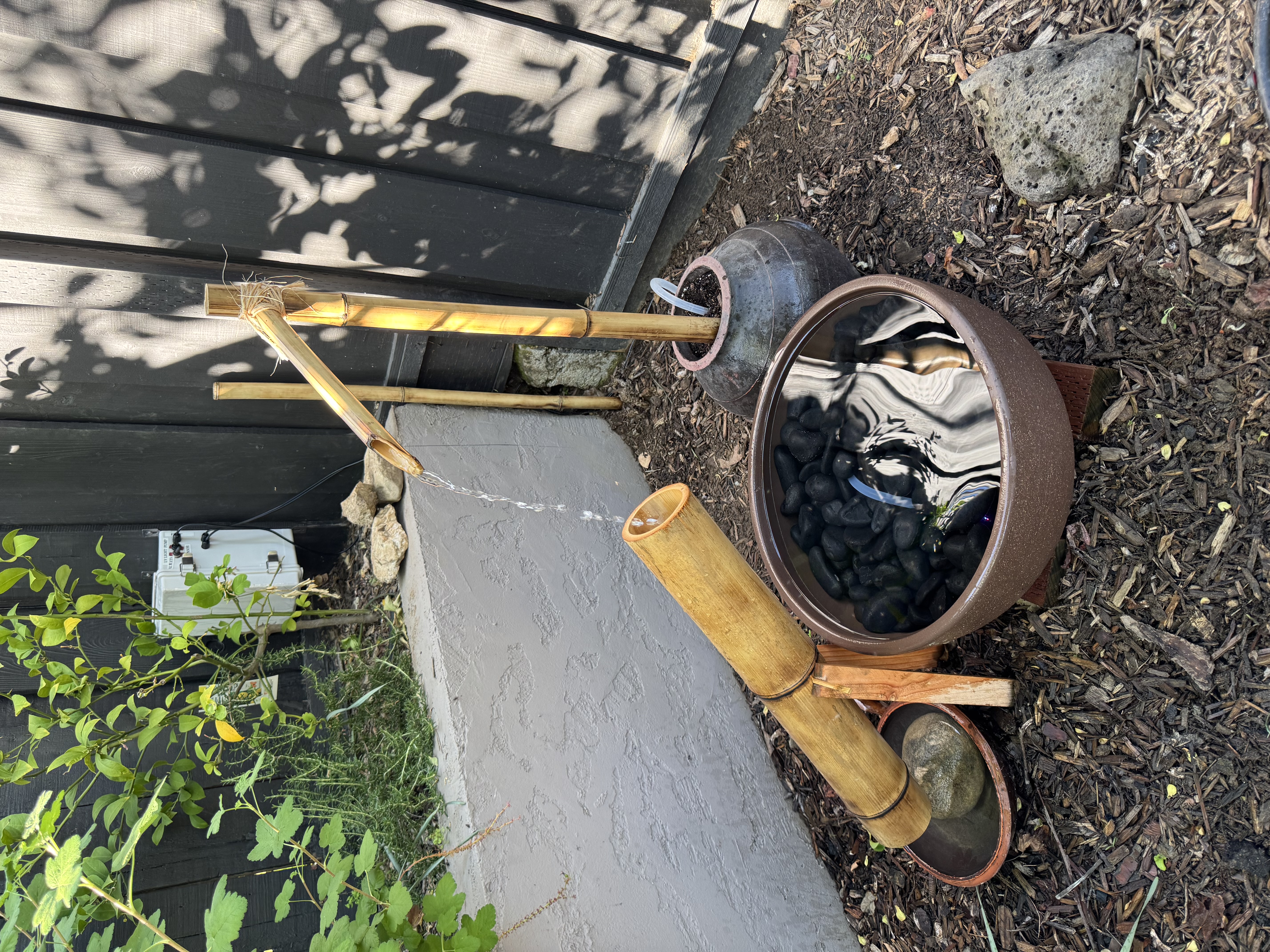
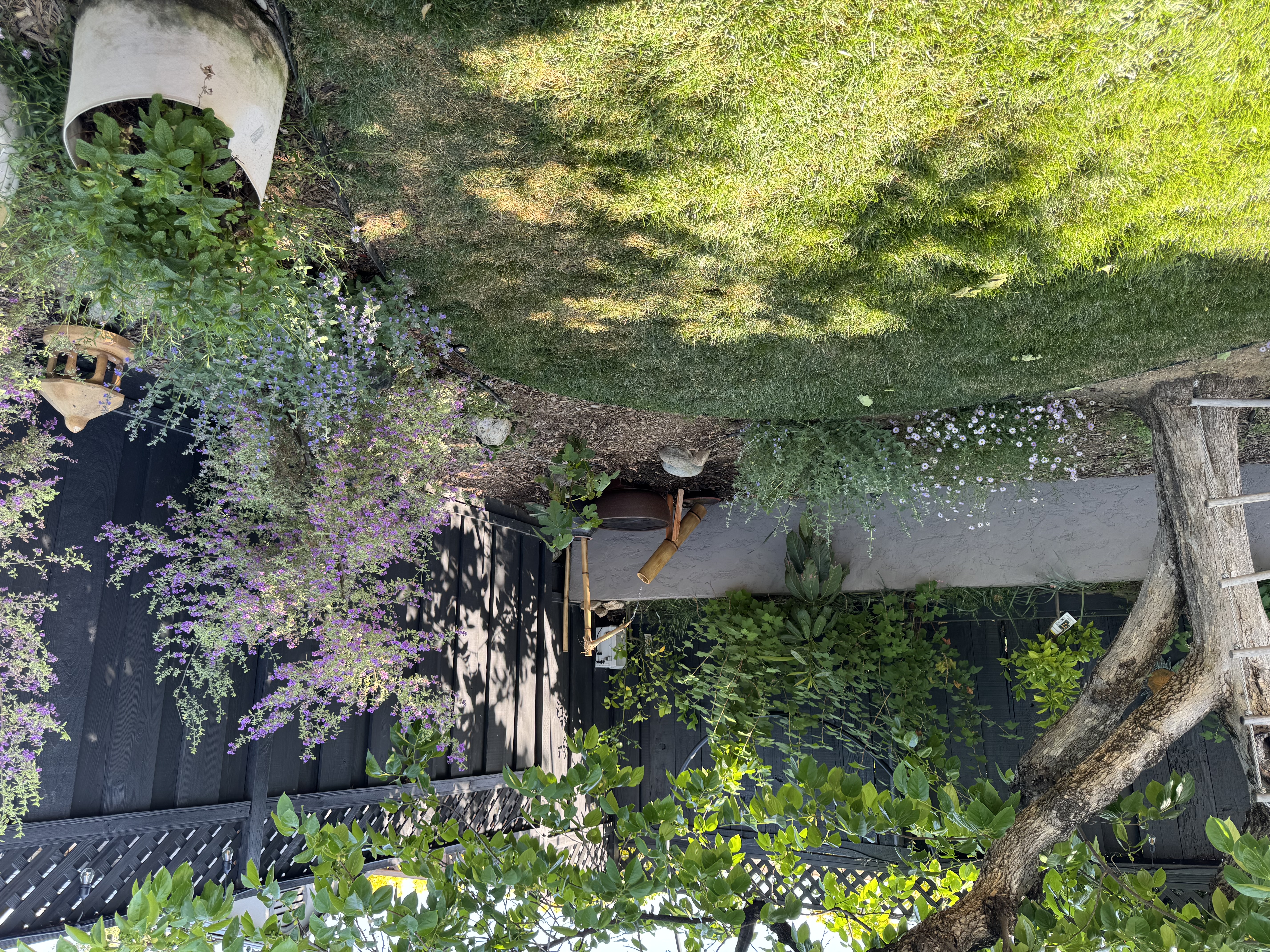
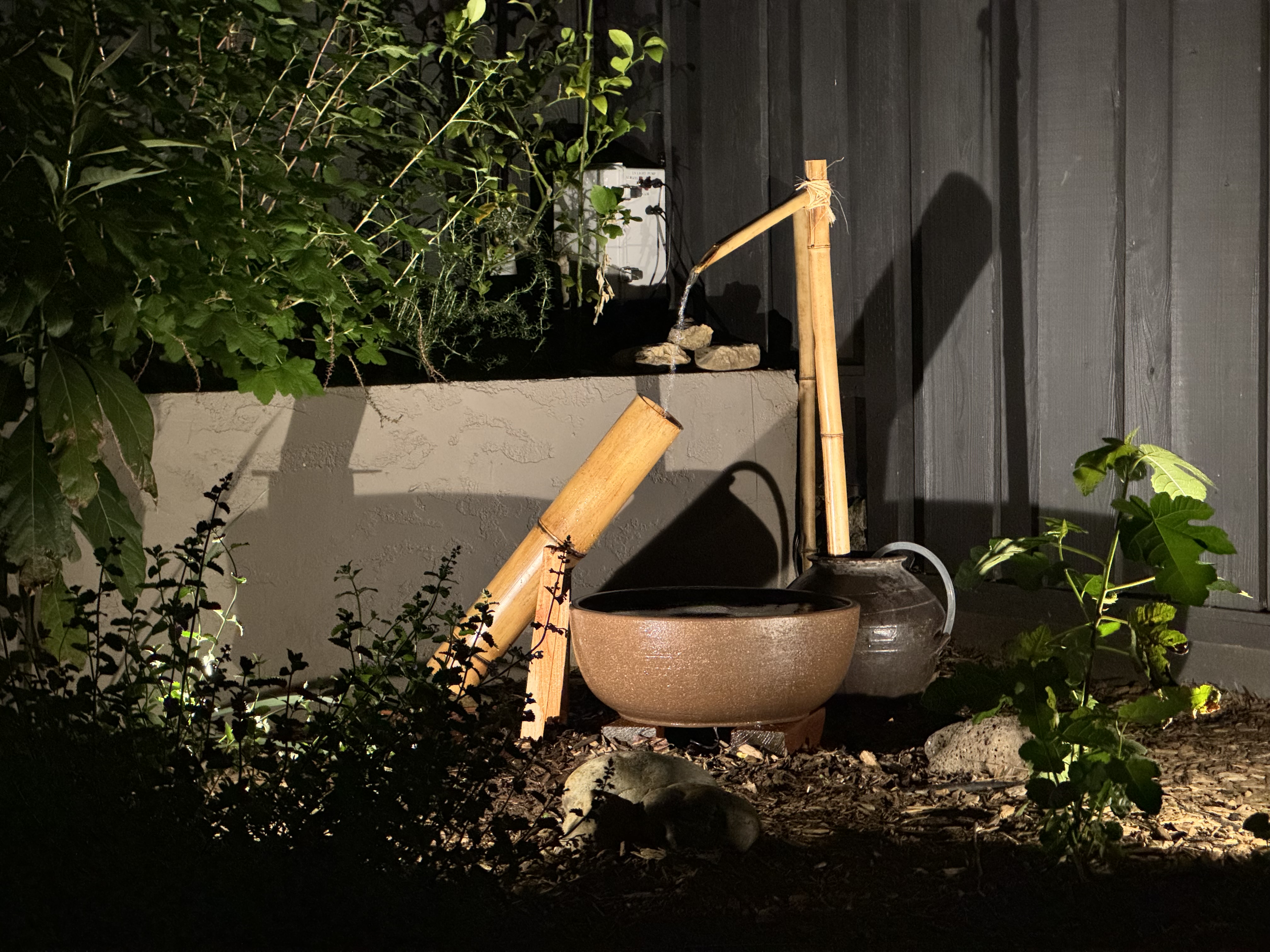
Over the past few months I've been tinkering away in our back yard building a Shishi Odoshi-- one of those Japanese fountains that go tock tock tock, you know, like in Kill Bill. Today I can call it finished, as I added the final touch of some landscape lighting to give it some life at night. Here are some scattered notes and write up on the project. Again, I'm bad at taking process shots but include some nice ones of the finished product.
Phase 1 - Fountain
First thing I did purchased was a vessel, which I found at Yamagami's Nursery in Cupertino. This was the right dimensions and came with two holes in the bottom, which would be perfect for routing tubing and wiring. I got two bags of black beach stones from the orange box store, and the project sat dormant for the next few weeks.
After browsing the web for pre made Shishi-odoshis, I was convinced I could make one myself. Bamboo was a bit hard to find, but I was able to source some (and I got a lot left over) from Bamboo Junkies off Etsy. I recieved a bunch of ~1-2" diameter and 4" diameter poles. For water circulation, I purchased a small 12v DC submersible pump (11-watts max) and some food-grade silicone tubing, both off Amazon. The first thing I constructed from bamboo was the spout. This was fairly straightforward. First I cut a hole in the thicker upright rod to fit the spout piece. Then I made a diagonal cut through a thinner pole to make the spout itself. Once I got the spout to fit well into the upright, I drilled a smaller hole towards the bottom of the upright to pass in the tubing. I also had to clear 2-3 internodes of the upright to allow the tube to pass through. Once that was all clear, I threaded the tubing in through the bottom hole, through the upright pole and out the spout hole. Then I attached the spout and adjusted the tubing so that it was hidden from view. The spout stayed in place by itself well enough, I considered gluing it in but for now I used some twine to bind the pieces together. It's not super solid but good enough.
For the base of the spout, I used an antique Oongi (earthen ware kimchi fermentation pot) that Julie had inherited from her family. I filled the Oongi with some stones and potting soil to provide support for the spout upright. I also tossed some fern plantlings in there, though I've yet to see anything sprout.
To provide circulation from the basin to the spout, I put the pump in the bottom of the basin and routed the spout tubing up through one of the bottom holes. I got an assorted set of rubber bungs from amazon, and drilled a hole large enough to pass the tubing. That went in one hole. I made a smaller hole in another bung to pass the power cable for the pump. This one required I slice through the side of the bung as I didn't feel like cutting off the barrel connector for the power supply. I think this made the bung leaky, which I think I fixed later with some silicone glue.
To test out the first phase of the fountain, I ran an extention cord to an old 12v ac-dc power supply. Success! I was able to get the pump to pull from the basin and send water down the spout. This allowed me to test for leaks and the general operation of the fountain. Generally speaking things worked well, though I was losing water faster than I liked. I think it was mostly from splashing -- as the stream from the spout makes contact with the water surface or even the beach rocks, lots of water spatters to the surrounding dirt. The stream itself can be more non-laminar than I'd like, casuing some unpredicatble pouring. This I'm able to mostly mitigate by rotating the beveled edge of the spout. I'd say I'd get about 1-1.5 days of circulation before the water level is too low for the pump. So far I'm just manually pulling the hose over to refill it. I'll think of other solutions later.
Phase 2 - Power and Control Unit
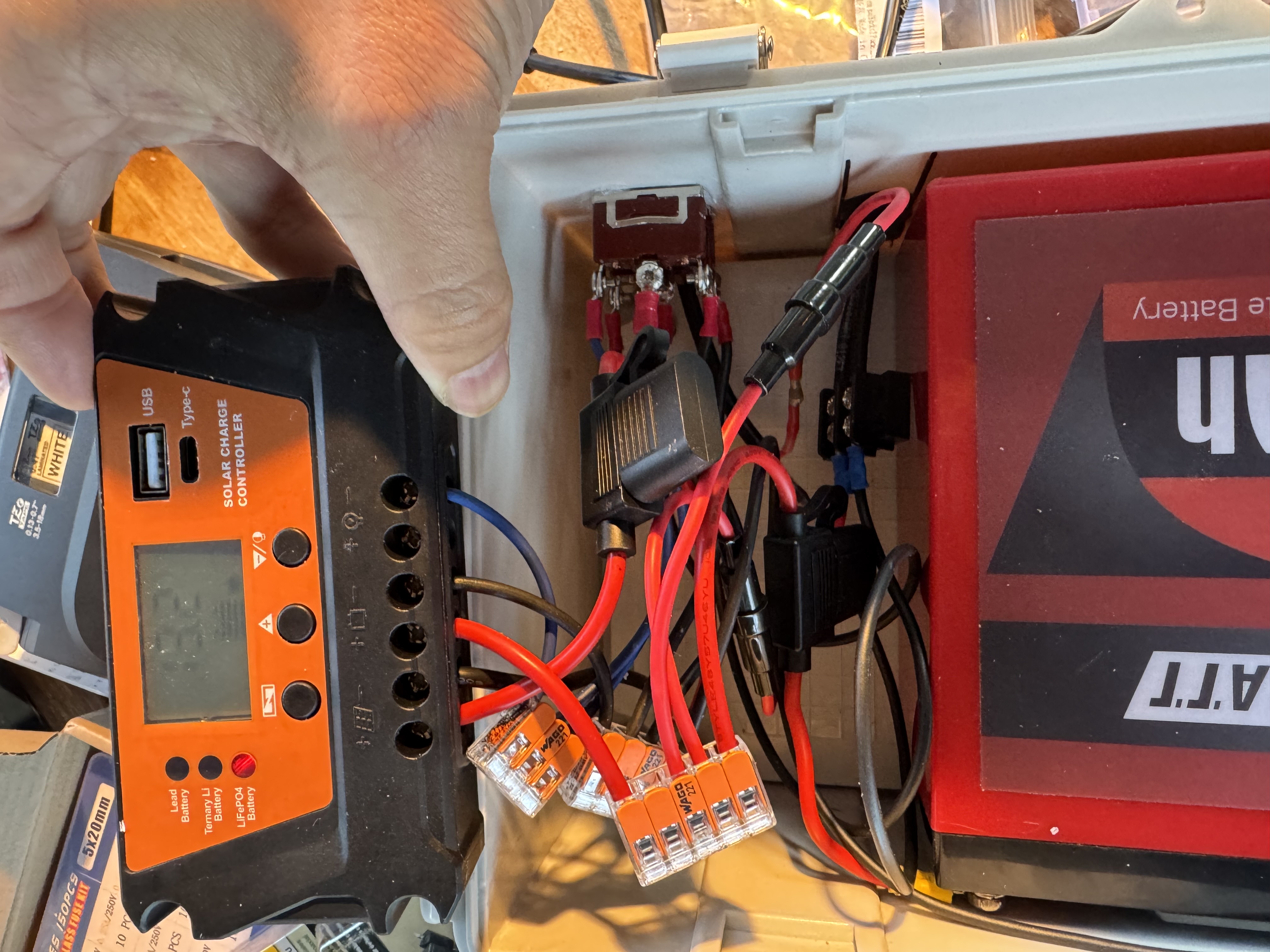
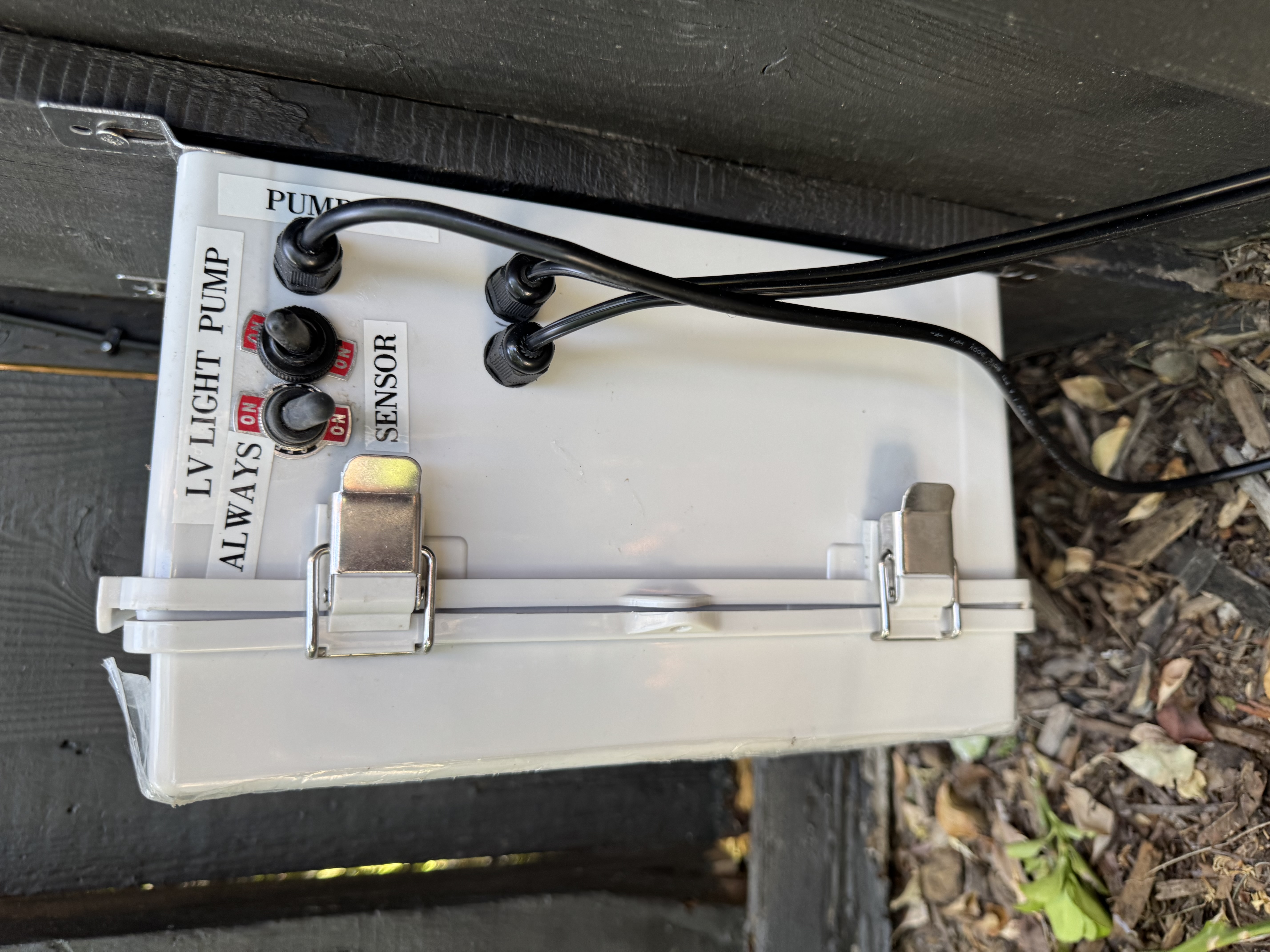
With the main part of the fountain complete, I spent the next couple weeks working on what I call the PCU - the Power and Control Unit. This is where the over-engineering comes in. For this I wanted to achieve the following: 1.) Use solar 2.) power the fountain pump 3.) power landscape lighting. The major components are as follows:
- 25 Watt, 12 V solar panel (eco-worthy)
- 30 Ah, 12 V LiFePo4 Battery
- Cheap PWM Solar Charge converter
- Project box
- Inline fuse holders, both blade and glass tube types
- Satisfying 3-way toggle switches
- Wago connectors, 14 gauge wiring
I wanted the additional functionality of being able to independenty control the pump and the lighting. On top of that, I wanted to be able to select between "always on" -- direct from the battery to "dusk-dawn mode" -- which is functionality provided by the solar charge convertor. This is was the 3-way toggle switches accomplished.
I started with a napkin sketch, assuming the negative rail was to be common or ground. Funny enough when I probed the charge controller that was not the case and positive was actually common. A search on ChatGPT said this was typical of cheap charge controllers, so I needed to re work my drawing so that the toggle switches connected to the negative terminals instead of the positive. I'm still a bit confused about what is considered ground in this case but will leave that for later. In addition to going over kill with some of the wiring (as thick as 12 gauge in some places, as thin as 16 in others) I probably went over kill with fusing. I put a 3 amp blade fuse from the Solar panel, 15 amp blade fuse at the battery, and glass tube fuses of 1.5 and 5 amps for the pump and lights loads, respectively. I figure with the outdoor wet environment electrical and long land scape wiring, it couldn't hurt to take these precautions. I used a combination of Wago connectors (awesome), heat gun solder tubes (I still suck at using them), crimp end connector ring terminals (my crimping game still weak) and some screw terminals to wire it all up. I got a surface mount SAE connector for the solar and used more cable glands for the pump and lighting wires. Tetrised it all in the box, put some holes in it, connected every thing and voila! Success! With this in place I was able to take down my extension cord and power the pump directly off battery/solar.
Phase 3 - Deer scaring
The last phase was to contruct the Shishi odsohi-er, which is the rocking, pouring, tocking piece. For this I took a 4" diameter bamboo with an open end, and drilled a hole below it's internode, roughly at its center of gravity, though biased so the open cup would tip upwards. I used a bamboo disposable chopstick as the axel and notched some wooden stakes I had to create the fulcrum. For the striking end, I placed a rock inside the lid of the oongi and finessed everything into place. I had to mess a bit wit the positioning but without too much fiddling am able to get it to run continuously.
Last last thing I did was to wire up the lightling. For this I used some old land scape lighting fixtures. I ditched the stock 30 watt halogen bulbs for 3 watt LEDs.
Comments, Next Steps
I'm super happy with how this turned out, I've been sitting in front of this for many minutes today. An ongoing concern is how quickly the fountain loses water. Splashing from the spout into the basin is less of a concern now, but the rocker-pourer itself can be pretty splashy. One mitigation would be for me to bevel the business end like the spout, this way as it's on its way tipping over, water can continue pouring into the cup rather than down the top of the outside. I'm a little reluctant to do that for now because I've acheived some sort of balance point, will likely need to mess with it some more if I take material and weight off of one end. The pouring part can also be a bit more abrupt than is ideal, and that causes some splashing and loss as well.
Ideally I can minimize the water loss, but between unavoidable splashing and evaporation, I'm going to need to refill this manually no matter what. I have a drip irrigation line running nearby, so I think the next phase of overkill will be to fill it using that.